Traditional Latin Mass in Hackensack, NJ
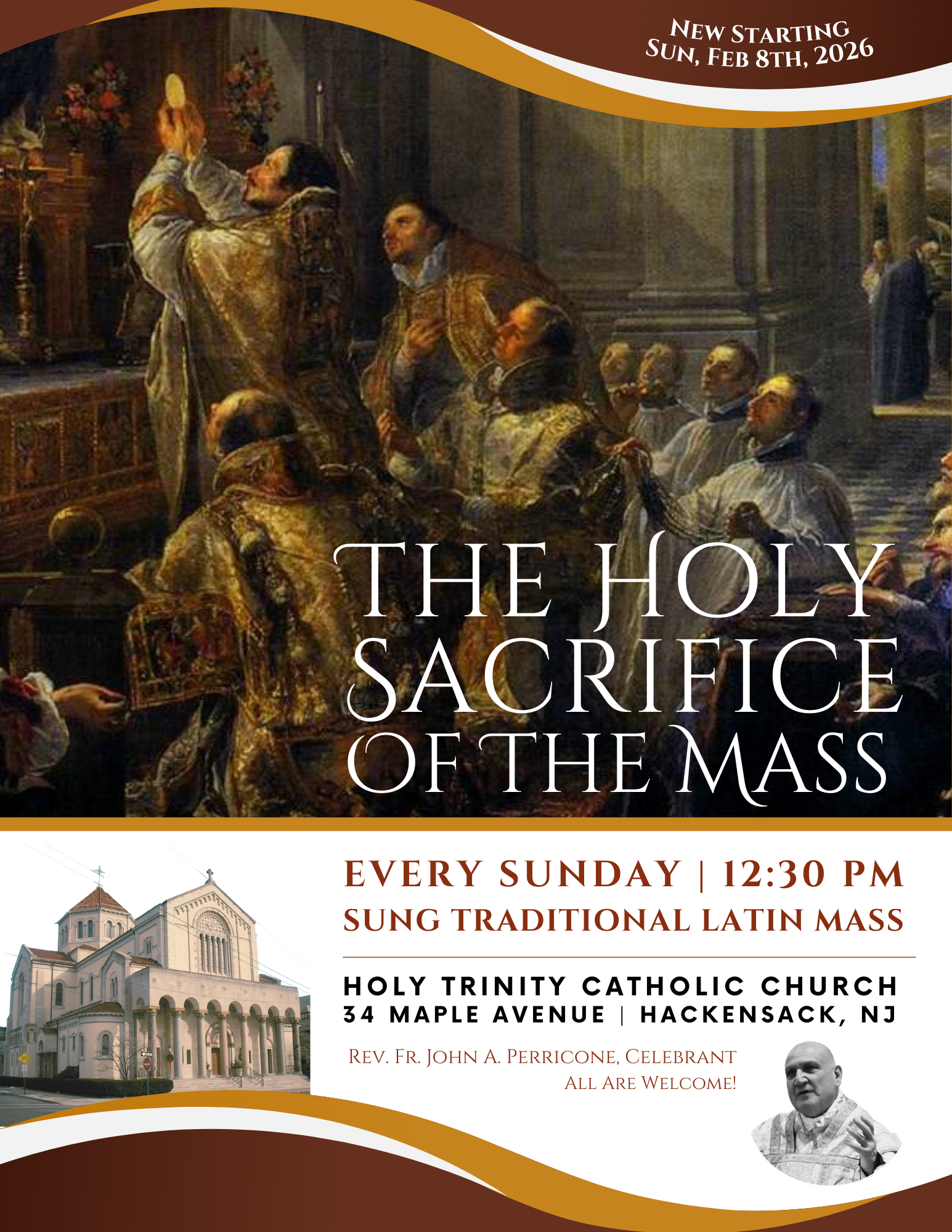
Click on image for map and directions.
New to the Traditional Latin Mass? Start Here.
If you are new to the Traditional Latin Mass, you are not alone — and you are very welcome.
Many people encounter this form of the Mass and immediately sense its reverence and beauty, yet feel uncertain about what is happening or how to follow along. That reaction is normal. The Traditional Mass was never meant to be rushed through or instantly “figured out.” It unfolds slowly and invites quiet attention.
One of the best ways to enter into it is by becoming familiar with the Propers of the Mass.
What Are the Propers — and Why Do They Matter?
At each Mass, the Church prays certain texts that change according to the day. These prayers and readings are called the Propers.
They are drawn largely from Sacred Scripture and are carefully chosen to reflect:
the liturgical season (Advent, Lent, Easter, etc.)
the feast or saint of the day
the spiritual focus the Church wishes to place before us
Rather than explaining the mystery of the Mass in plain language, the Propers allow the Church to pray the mystery. Over time, the same themes return year after year, gently forming the soul.
For newcomers, reading the Propers ahead of time can:
make the Mass feel less unfamiliar
reveal the Church’s intention for the day
deepen recollection and prayer, even when you don’t “follow every word”
Do I Need to Understand Latin?
No — not in the way you might expect.
Latin is used because it is:
a sacred and stable language
precise and doctrinally careful
no longer changing in meaning
You are not expected to translate everything in your head. Many longtime worshippers do not. The Traditional Mass is meant to be entered into prayerfully, not mastered intellectually.
The Propers help by giving you the meaning of the day’s prayers in advance, so that when you hear them sung or read at Mass, they resonate more deeply.
Why Are There Two Liturgical Calendars in the Roman Catholic Church?
The Roman Catholic Church currently uses two distinct liturgical calendars, both valid and authorized, each corresponding to a different form of the Roman Rite.
1. The Traditional Roman Calendar (1962 Missal)
This calendar developed organically over many centuries and was codified in the 1962 Roman Missal, the last edition before the Second Vatican Council.
It features:
Seasons such as Septuagesima, Sexagesima, and Quinquagesima
Ember Days and traditional vigils
A one-year cycle of readings for Sundays
A strong penitential rhythm preparing the soul for Easter
This calendar is used in what is commonly called the Traditional Latin Mass.
2. The Post-Conciliar Calendar (introduced after 1969)
Following the Second Vatican Council, a revised calendar and lectionary were promulgated, introducing:
A three-year Sunday reading cycle
A simplified seasonal structure
Revisions to feast rankings and saints’ days
Expanded Scripture exposure across weekdays and Sundays
This calendar is used in what is commonly called the Novus Ordo Mass.
Why This Website Uses the Traditional Propers
The Propers posted here follow the Traditional Roman Calendar and Missal, reflecting the form of the Mass celebrated by Father Perricone.
These texts:
Preserve the historic prayers of the Roman Rite
Emphasize doctrinal continuity and theological clarity
Invite the faithful into the Church’s ancient rhythm of prayer
They are offered not as a novelty, but as a living inheritance—one that continues to sanctify souls today just as it has for generations.
We encourage visitors to return each week, read the Propers in advance, and allow the Church’s own prayers to form their hearts and minds before coming to the altar.
How to Use the Weekly Propers
If you are new, we suggest a simple approach:
Read them once before Mass — slowly, without pressure
Bring them with you or recall their themes
Listen and pray, even if you lose your place
Let the words return to you afterward
Understanding will grow naturally. Familiarity comes quietly.
What’s so special about the Latin Mass?
Hear Father Perricone eloquently describe the beauty of Latin in the Mass in response to a question from one of his lectures.
A Final Word of Encouragement
The Traditional Latin Mass is not a performance to watch or a text to decode. It is an act of worship in which Christ offers Himself to the Father, and we are invited to unite ourselves to that offering.
The Propers are the Church’s own prayers, given to help us do just that.
Take your time. You belong here.